History
Built on the Shoulders of Giants
Origins of the Air Medical Safety Network
The Air Medical Safety Network (AMSN), and specifically its Air Medical Learning Network (AMLN), builds on the foundation laid by the CONCERN Network. In 1984, the CONCERN Network was formed so that an incident or accident at one program would be known at every other program within hours. For four decades, it carried the premise that safety knowledge belongs to the people who fly, and that programs should share it with one another.
- 1984Established by the National Flight Nurses Association, now ASTNA
- 65Members reached by the first telephone network in 1984
- 3,000+Email addresses receiving bulletins by the mid-2000s
- 90+Concern Network publications in Air Medical Journal, 2001 to 2018
Established 1984
The CONCERN Network
Established in 1984, the CONCERN Network (CoOperative Network Call for Emergency Regional Notification) was one of the earliest organized safety initiatives in civilian air medical transport. Created by the National Flight Nurses Association (NFNA, now ASTNA), the network was established to share information about accidents and safety incidents within the air medical community.
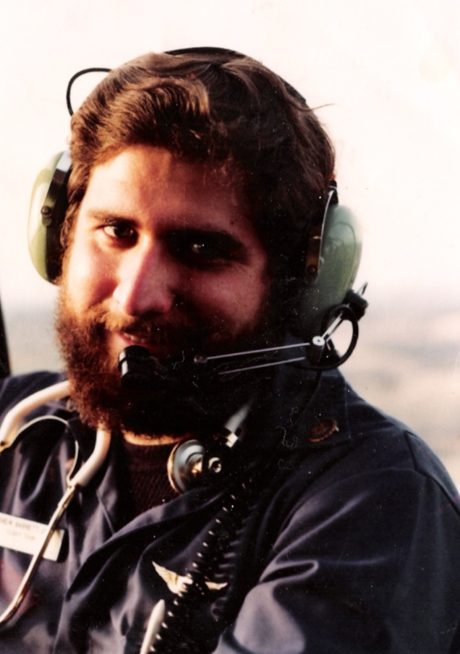
Andrew Barrett conceived the network. He was an NFNA board member and chaired its Liaison Committee. CONCERN began as a telephone notification system to inform the community when transport crew members were injured or killed. Over time, it evolved into an email notification service that distributed bulletins about accidents, incidents, and other safety-related events. CONCERN was a voluntary network. Programs chose to share what they learned, and volunteers led it.
The purpose
Three goals for one phone call.
When a program had an accident or incident, the news spread by word of mouth. Other programs called to find out what happened. CONCERN was built to replace that with one verified message.
-
1
Fewer calls to a program in crisis
A program that had just had an accident would get fewer calls from others looking for information.
-
2
Less rumor
Confirmed facts would limit rumors and misinformation.
-
3
Same facts, same time
Every program would get the same verified information at about the same time.
In their words, 1985
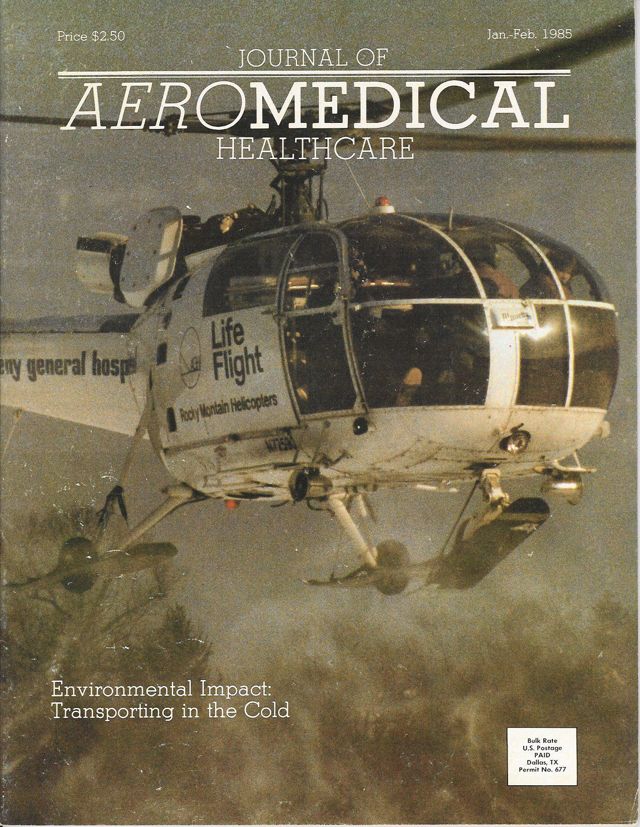
"Concern... implies an anxious sense of interest in, or responsibility for, something/someone."
"C.O.N.C.E.R.N.'s primary purpose is the timely distribution of accurate information to all flight programs in the event that an incident occurs."
Andrew S. Barrett, CRNP, CEN, Chairman of the Liaison Committee, National Flight Nurses Association. Announcement in the Journal of Aeromedical Healthcare, January to February 1985.
Why it began
Air medical transport in the early 1980s.
The field grew fast, and the conditions crews worked in were different from today. These were the conditions that led to CONCERN.
- The number of programs was rising quickly.
- Competition between programs was intense.
- Pilot pay was based on rotor time.
- Rules on pilot duty time and weather minimums were less strict.
- Navigation aids were limited by today's standards.
- Aircraft and maintenance were far less reliable than today.
- The crash rate was seen as higher than in other areas of aviation.
1984: the first network
How one call set CONCERN in motion.
Each program added one access number to its emergency notification plan. A single call to that number started the network. Step through it below.
1986: the fax tree
One page, sent to every program.
In 1986, Roseann Krantz developed the CONCERN fax tree. It became the network's main channel for most of the next two decades.
The telephone network passed each message by voice, one call at a time. A fax sent the same written page to every program, so every program read the same words. Short fax calls, many sent at night when rates were lower, also cut the cost.
The point of contact moved to LifeFlight in Fargo, North Dakota. In the late 1990s, it moved with Roseann to Columbia, South Carolina. The fax tree stayed the main channel even after the first email lists began. Email became the preferred channel when Roseann retired in 2004.
Four decades of change
From telephone to fax to email to the web.
The way CONCERN carried the news changed with the technology. The goal stayed the same. Choose an era to see how it worked.
A telephone network
A program called Life Flight Control at Allegheny General Hospital in Pittsburgh, Pennsylvania. A coordinator confirmed the details by calling back. NFNA board members then called the other member programs.
- Point of contact
- Life Flight Control, Allegheny General Hospital, Pittsburgh, PA
- Reach
- 65 ASHBEAMS members in early 1984
The fax tree
Roseann Krantz developed a fax tree. Fax machines were new, and they sent the same written message to every program. Shorter calls, and night rates, also saved money. In the late 1990s, the point of contact moved with Roseann to Columbia, South Carolina.
- Point of contact
- LifeFlight, Fargo, ND. Later Columbia, SC.
- Developed by
- Roseann Krantz
Early online groups
In the early to mid 1990s, before the web, some programs tried AOL groups and community bulletin board systems. These had limited success. The fax tree remained the main channel.
- Main channel
- Fax tree
The first email lists
As the web arrived, the first CONCERN email lists began. The fax tree was still the main channel. During this period, critical care ground transport was recognized as part of the community.
- Email lists developed by
- Alan Dobrowolski, Rollie Parrish, and David Kearns
Email becomes the main channel
Roseann Krantz retired in 2004. The point of contact moved to Flight For Life Colorado. Email became the preferred channel, and the fax tree was no longer as vital.
- Point of contact
- Flight For Life Colorado
The CONCERN website
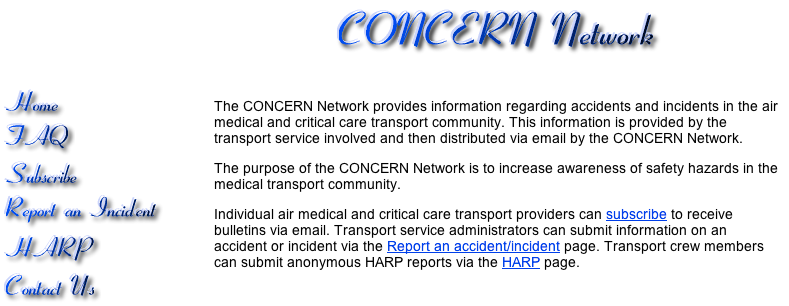
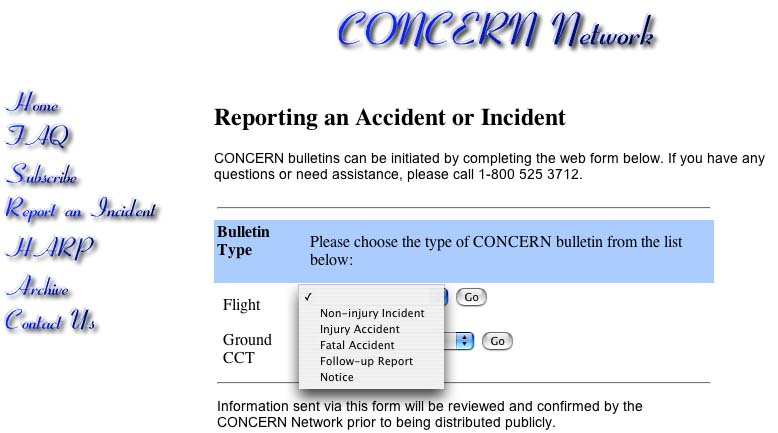
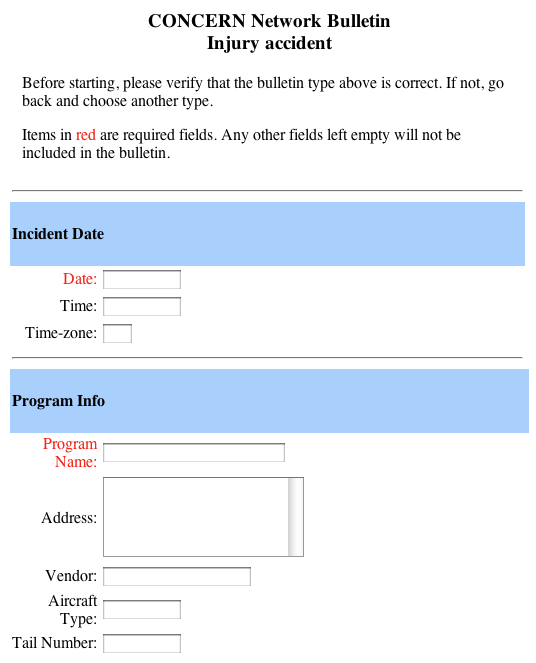
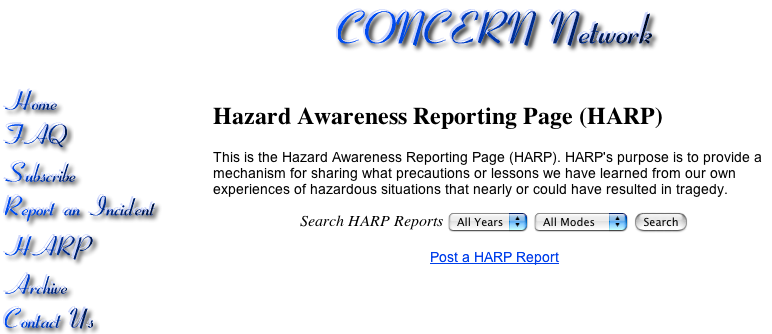
CONCERN launched its website, concern-network.org. Programs started a bulletin by filling out an online form. A phone call still verified every report. ASTNA's Hazard Awareness Reporting Page (HARP) became part of CONCERN.
- Website
- concern-network.org
- Reach
- More than 3,000 email addresses by the mid-2000s
The bulletin process
How a bulletin was issued.
By the mid-2000s, each bulletin passed through four steps. Verification by phone stayed in place from the first year to the last.
- 1
Report
A program reported the event by web form, phone, email, or fax.
- 2
Verify
A coordinator called the program back, using a phone number found independently. The call confirmed the program meant to send a bulletin and confirmed the details. It also prevented false reports and gave a chance to correct errors.
- 3
Format
A communications specialist formatted the bulletin for email.
- 4
Send
The bulletin went to more than 3,000 email addresses. Plans were under way to let readers choose air or ground, rotor-wing or fixed-wing, and all events or fatal events only.
What it covered
What merited a bulletin.
A bulletin covered any event, in any phase of flight, that took an aircraft out of service for inspection or repair, or that injured anyone on board. The same rule applied to ground transport.
- Interruption of normal operation
- Non-injury incident
- Accident with minor injury
- Accident with major injury
- Accident with fatality
Precautionary landings and stops
These could merit a bulletin when a condition might affect other aircraft or ambulances of the same make or model.
Follow-up
Later bulletins shared causes, release of names, corrections, and memorial services.
Special notices
Other information the community needed to know.
Close calls and narrow escapes
The Hazard Awareness Reporting Page.
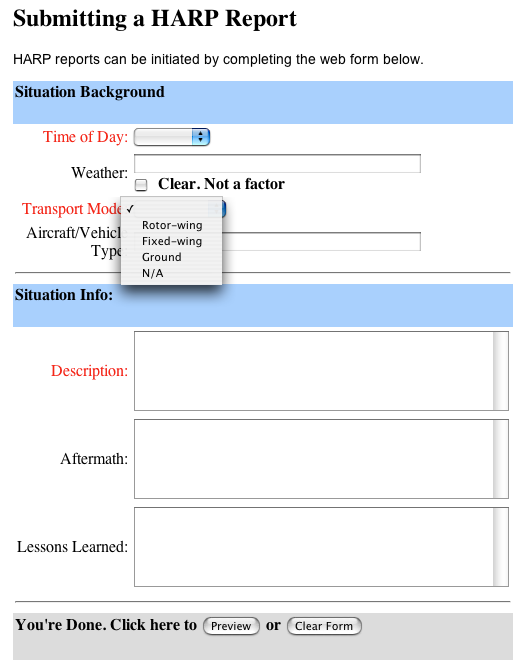
ASTNA began the Hazard Awareness Reporting Page (HARP) in 2000. Its aim was to raise awareness of close calls. A HARP report involved no damage and no injury. Something was learned, and a policy or procedure may have changed as a result.
HARP gave the community another way to warn of a shared hazard. Reports were moderated, and reporters were not identified. HARP became part of CONCERN in 2005.
The Air Medical Learning Network builds on the same idea. Good catches and close calls carry lessons, even when nothing goes wrong.
Questions for the future
Questions CONCERN asked about its future.
In the mid-2000s, David Kearns asked where CONCERN should go next. Two of his questions shape AMSN's work today.
Should CONCERN include patient safety information?
AMSN covers operational and clinical safety. The Air Medical Learning Network invites lessons from patient care as well as flight operations.
Should CONCERN's records support statistical analysis?
The Accident Database supports analysis of air medical events. An archive of CONCERN bulletins is in development.
Before the standards
An early, grassroots effort.
The network formed before several industry milestones. These included the NTSB's first helicopter air ambulance safety study (1988), CAMTS accreditation (1991), and the Certified Flight Registered Nurse (CFRN) credential (1993). CONCERN represented an early, grassroots effort by the air medical community to learn from accidents and incidents before many formal safety standards and oversight programs were introduced.
- 1984CONCERN Network established as a telephone network
- 1986Fax tree developed by Roseann Krantz; main channel into the 2000s
- 1988NTSB's first helicopter air ambulance safety study
- 1991CAMTS accreditation
- 1993CFRN credential
- Late 1990sFirst email lists
- 2000HARP begun by ASTNA for close calls
- 2001Bulletins begin in Air Medical Journal
- 2004Email becomes the preferred channel
- 2005concern-network.org launched; HARP joins CONCERN
- 2012Journal section moved online-only
- 201818 years of bulletins in the journal
- 2026The Air Medical Safety Network and its Air Medical Learning Network (AMLN) build on CONCERN's foundation
Four decades of records
A record beyond the accident databases.
For more than four decades, CONCERN was a trusted source of safety information and historical records. Air Medical Journal published its bulletins, and researchers used its records to study transport safety. CONCERN also captured events that rarely reach NTSB records. These included precautionary landings, incidents without injuries, ground transport crashes, and lessons from member programs.
Its lasting contribution
Its lasting contribution was the habit of sharing. Programs that reported what happened gave others a chance to prevent the same event.
Publication record
Publication record in Air Medical Journal
Between 2001 and 2018, at least 90 publications appeared under the title Concern Network. Early publications were concise, often a single page. Later editions included detailed tables and descriptions of accidents and incidents, documenting dates, aircraft or vehicle types, weather conditions, injuries, and the circumstances surrounding each event. Beginning in 2012, the section transitioned to an online-only format. Air Medical Journal is the official journal of five air medical professional associations. Publishing the bulletins there widened CONCERN's reach and preserved its reports for education and research.
Sources. David Kearns, MS, RN, CFRN, CONCERN Coordinator, "The CONCERN Network: Origins and Future Directions" (presentation). Andrew S. Barrett, announcement of C.O.N.C.E.R.N., Journal of Aeromedical Healthcare, January to February 1985. Images, including the concern-network.org screens from about 2005, are from David Kearns's presentation.